
The Concourse and the changes it faces
MANDATE? WHAT MANDATE?
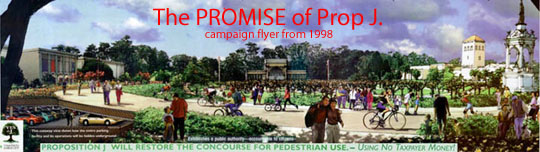
Proposition J was approved by San Francisco voters in 1998 to: "1) create a
pedestrian oasis in the Music Concourse...and 2) take steps to reduce the impact
of automobiles in the Park."
To achieve these ends, it established the Golden Gate Park Concourse Authority, with
sweeping powers over the entire Park, including the ability to build an 800-1000
car underground garage in the Music Concourse, using only private funds.
In other words, Prop J MANDATED the creation of a pedestrian oasis and mass transit
improvements, and it AUTHORIZED the construction of a garage.
By contrast, the Concourse Authority has stated that their mandate is the completion
of an underground garage in time to serve the opening of the new deYoung Museum.
The Fine Arts Museums of San Francisco (FAMSF) are pulling out all the stops to complete
the new museum, and the Concourse Authority is tripping over itself in its attempt
to comply. They are poised to replace a century-old historic landmark, the Music
Concourse, with a time-compromised low-budget project, in the heart of Golden Gate
Park. THIS IS A RADICAL RESTRUCTURING OF THE TEXT AND THE SPIRIT OF PROPOSITION J.
NOT RESPONSIVE TO PUBLIC INPUT
In their haste to accommodate the Museums' schedule – and the donors' budget -- the
Concourse Authority, supposedly a "public authority, accountable to citizens,"
has shown a remarkable disregard for the public good.
For example, when it became apparent that the Asian Art Museum, which was in the
west wing of the deYoung, would not be able to move downtown until early next year,
the footprint of the new deYoung was moved eastward, resulting in the destruction
of the very stand of trees the Environmental Impact Report claimed would hide the
structure's bulk from Park visitors.
Also, although the Arts Commission and the Recreation and Park Department pleaded
with them to preserve the beloved Pool of Enchantment during the demolition of the
deYoung, the FAMSF ruthlessly crushed all but a few pieces of this priceless treasure,
claiming that a safe removal would "take too long".

The reason behind these decisions is simple: the FAMSF control the donors, and the
donors control the Authority. This means that any appearance of public accountability
on the part of the Authority is more PR than reality.
BARGAIN BASEMENT GARAGE
Another way the Concourse Authority has shown its disregard for public opinion is
in the design of the garage itself. During public workshops two years ago, the public
overwhelmingly voiced their support for the "no garage" option. Their second
choice was to build a single garage, confined to the north side of the Concourse.
But the Concourse Authority, ignoring this input, went ahead with the design which
the donors had decided on before the workshops were even initiated -- a far more
intrusive plan calling for two garages. After cost estimates, they decided that this
design was too expensive, and started cutting out amenities. Then, after settling
on a cheaper version, they decided that it would still be too expensive, and cut
corners even further.
In the current design, natural lighting and ventilation have been removed, parking
and ramp angles increased, soil thickness on the surface reduced, and a host of other
cost-cutting changes introduced. Also, in violation of the requirements of Prop.
J, an entrance and exit are located inside the Park. Now sources tell us that the
funders intend to seek PUBLIC REVENUE BONDS, to cover the cost overruns of their
“privately funded” garage.
PROJECTS OF MASS DISRUPTION
These are the current Concourse construction schedules:
DeYoung Museum: mid 2002 to mid 2005
Concourse Garage mid 2003 to mid 2005
Academy of Sciences late 2003 to late 2007
The combined projects will require the removal of 550,000 cubic yards of dirt from
the Concourse -- meaning 30,000 round trips by dump truck. The excavation for the
deYoung has already resulted in the removal of about 2,500 loads of dirt.
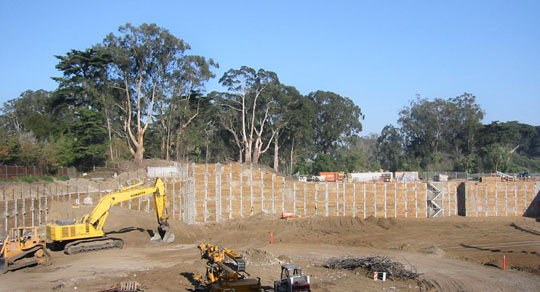
When the construction begins on the Garage, and later, on the Academy of Sciences,
will the Music Concourse survive?
ENVIRONMENTAL IMPACTS
San Francisco Tomorrow and the Alliance have demanded that the Planning Department
conduct a single Environmental Impact Report for all the projects in the Concourse,
instead of considering them all in isolation, as they are doing now. A comprehensive
EIR is the only way to assess the true impacts of these massive construction projects
on the Park, the surrounding neighborhoods, and the city. But in violation of the
California Environmental Quality Act, the City Attorney's office is refusing to force
the Planning Department to comply with this request.
PEDESTRIAN OASIS?
The Sierra Club and the Alliance have defined "pedestrian oasis" to mean
NO PRIVATE MOTOR VEHICLES in the Concourse. But the current garage design makes it
clear that this was never what the Concourse Authority had in mind. First of all,
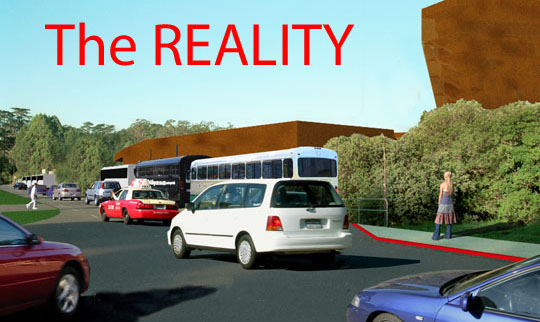
pedestrian sidewalks have not yet even been discussed by the Authority. The Concourse
will remain as the major north-south route for private motor traffic through the
Park and enough parking for seven tour buses will be ADDED in front of both museums.
In the four years since Prop J was passed, not only has the Concourse Authority never
defined the concept of a pedestrian oasis, but has seemed reluctant to even discuss
it. In fact, as far back as 1999, Concourse Authority
President Nancy Conner announced at a Board meeting that the Authority had the "task"
of building a garage, and the "hope" of creating a pedestrian oasis.
Webster's Dictionary defines "oasis" as "a fertile spot in the desert".
But to the Concourse Authority, it seems, “pedestrian oasis" means a tiny island
for pedestrians surrounded by a sea of speeding vehicles, which you can get
to only by caravan -- DODGE Caravan.
KISS THOSE PEDESTRIAN TUNNELS GOODBYE
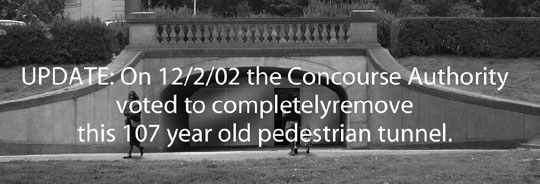
The historic pedestrian tunnel system has provided a safe haven for pedestrians for
over a century. But the Concourse Authority, after portraying them to the public
as "scary" and "dangerous", has called for three of the four
tunnels to be destroyed. They are planning to “replace” two of them with steel culverts,
and fit the portals of the third with glass doors that will serve as entrances to
the Garage.
Thus the new design, rather than enhancing pedestrian safety inside the Park, actually
destroys pedestrian access to and through the Concourse.
HOC CREDO (we believe)
The Alliance believes that the Concourse Authority has shown itself to be incapable
of creating BOTH a pedestrian oasis AND an underground garage. Perhaps they should
forego the construction of the garage, and focus on turning the Concourse into a
world-class pedestrian oasis, as mandated by Prop J.
The public has made it clear that this is what they want: a beautiful, peaceful,
joyous, safe haven in the middle of Golden Gate Park. Now it's up to us to make this
dream a reality.
The Music Concourse Garage, an Economic Analysis
Howard Strassner, Sierra Club Transportation Chair
This is the way it was in 1998:
Parking in Golden Gate Park was free except on weekends and holidays in the Concourse.
Those who were lucky or willing to walk a little had their favorite spots that were
close to their destination in the Park. The institutions reported that there was
adequate parking for their patrons except on Sundays when JFK Drive was closed to
auto traffic, and for major "blockbuster” exhibits.
The total annual revenue collected by the Recreation and Parks Department from parking
fee boxes in the Concourse, $100,000, indicates that there were enough people who
wanted convenient parking at $1/hr. to keep these 200 spots filled. Museum and Academy
employees and docents had free parking near the Institutions. The institutions found
some relief from their perceived Sunday parking shortage by instituting a shuttle
with $3 all day parking at the nearby UC Hospital garage. This was not completely
successful because of inadequate publicity.
This is the way it will be in 2005 as proposed by Prop J:
Over 400 parking spaces near the Concourse and 400 spaces elsewhere in the Park will
be removed. This will require Park visitors who want free parking to park even further
from their destination than they did in 1998. Because most people are willing to
walk rather than pay for parking, the garage may not have enough parked cars to cover
the cost of operation. These costs, based on similar proposed garages in San Francisco,
will require a minimum parking fee of about $2/hr. This level of parking fee is acceptable
to some museum patrons because they currently pay valet parking fees of $8 for events
at the Legion of Honor. If the garage actually provided all the transit assistance
which is mandated by Prop J, the parking fee could increase to over $4/hr. This will
be acceptable to even fewer patrons. The problem is that the proposed garage is too
big and many of the operating costs are a function of size.
A Suggested Alternative with no Garage and "Market Rate" Surface Parking:
The Concourse will be a "Pedestrian Oasis" as required by Prop J. This
will result in the removal of 200 Concourse parking spaces. The spaces closest to
the institutions will have parking fee boxes similar to those now in the Concourse,
with a fee of about $2/hr. This fee will apply seven days a week and probably into
the evenings to insure that close-in spaces will be available for evening events
at the institutions. Spaces a little further away will have a $1/hr. fee. The fee
and size of these fee areas will be based on demand so that the institutions can
advertise that ample parking is available for patrons who are willing to pay. Further
out parking will be free the same as it is now. This kind of parking will not have
most of the costs associated with underground parking garages, and no parking tax.
Thus Rec. and Park will net about $500,000 a year after some expense to install and
maintain the fee boxes plus some enforcement. This will help maintain the Park and
could provide some assistance for improved transit. In addition, the civic-minded
philanthropists now ready to pour $40,000,000 into a hole in the ground could use
their money to better assist the institutions they seek to support